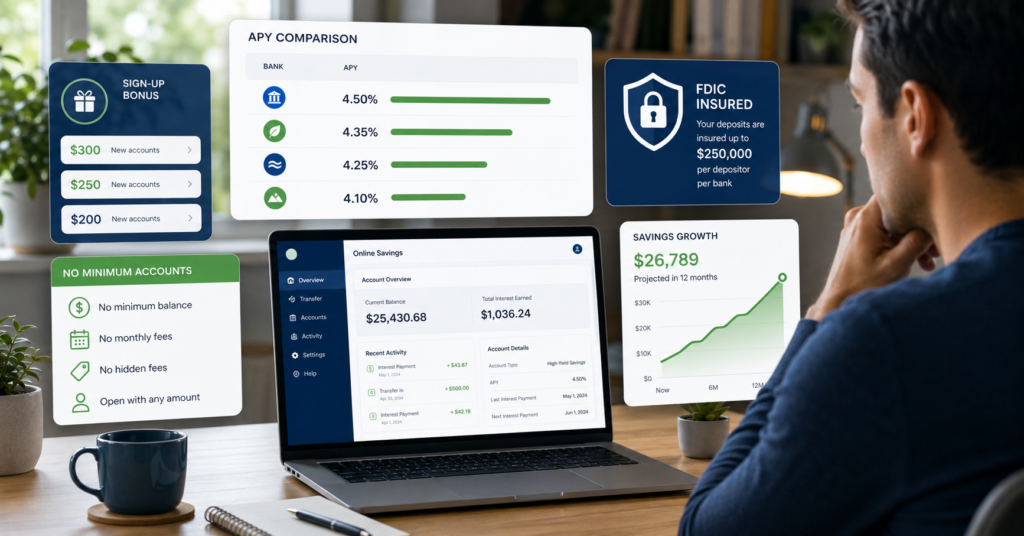
The best high-yield savings accounts 2026 can help your cash earn more without adding market risk.
However, the best account is not always the one with the highest headline APY.
Also, bonus rules, minimum deposits, transfer speed, and fees can change your real return.
Therefore, this guide compares HYSAs like a real saver would compare them.
Why You Should Compare HYSAs in Today’s Rate Environment
Rates keep moving, and that makes comparison more important in 2026.
The best high-yield savings accounts 2026 usually combine strong APY, FDIC insurance, no monthly fee, and easy transfers.
However, bonus accounts may beat higher APY accounts for short-term savers.
Therefore, compare your expected balance and time frame before opening anything.
Optimizing returns as market rates keep shifting
First, I check whether the APY applies to my full balance.
Next, I check if the account has balance caps or activity requirements.
Finally, I compare how fast I can move money out.
For example, a 4.16% APY account can beat a 4.30% teaser account.
That happens when the teaser account limits the high rate to a small balance.
Also, some banks require new money to qualify for bonuses.
- Check the ongoing APY, not only the promotional rate.
- Review monthly fees and minimum balance rules.
- Confirm FDIC or NCUA coverage before depositing cash.
- Compare transfer speed if the money is an emergency fund.
- Read bonus rules before opening a promotional account.
In fact, my first HYSA mistake was chasing the top number.
As a result, I missed a better account with cleaner rules.
Now I compare the full return, not only the APY.
Best High-Yield Savings Accounts 2026 with Sign-Up Bonuses
Sign-up bonuses can add fast value when the rules fit your cash plan.
However, a bonus should never hide a weak long-term account.
I compare the bonus, required deposit, holding period, and ongoing APY together.
How welcome bonuses add instant extra earnings
A welcome bonus works best when you already have idle cash.
For example, a $200 bonus on a $30,000 deposit adds quick extra yield.
However, the account may require a 60-day or 90-day holding period.
Also, some banks limit bonuses to new customers only.
Therefore, I read the offer terms before moving money.
I personally use this type of bonus account only when the holding period fits my cash calendar. Check today’s top HYSA bonus offers before you commit.
- Best for emergency funds: no monthly fee and fast transfers.
- Best for large cash: strong APY plus a realistic cash bonus.
- Best for beginners: no minimum deposit and simple mobile setup.
- Best for rate chasers: easy external transfers and no closure fee.
Additionally, compare the bonus against the APY you might lose elsewhere.
For example, a higher bonus may still lose if the ongoing APY drops fast.
As a result, the best bonus account should still work after the promo ends.
No-Minimum High-Yield Savings Accounts for Easy Entry
No-minimum accounts help new savers start without waiting for a large deposit.
However, easy entry should not mean weak account terms.
Therefore, I compare APY history, fees, signup steps, and bonus conditions together.
High-yield options that work with small starting deposits
First, a no-minimum HYSA should let you open with $0 or $1.
Next, it should avoid monthly maintenance fees.
Finally, it should offer a competitive APY across normal balances.
For long-term comparison, I track APY ranges instead of one-day rankings.
For example, my 2026 watchlist uses a 3.30% to 4.16% APY planning range.
Also, I compare that range against prior year trend changes.
- 2024 trend: many online HYSAs stayed attractive after rate hikes.
- 2025 trend: several APYs drifted lower as rate expectations changed.
- 2026 trend: top online accounts still beat many branch banks.
- Planning range: 3.30% to 4.16% helps model realistic yearly earnings.
However, APY alone does not decide the best account.
A beginner with $500 needs a simple signup flow and no fees.
A saver with $30,000 needs stable APY and clear transfer access.
For scenario one, I would pick a no-minimum account with no monthly fee.
Also, I would skip a bonus if it requires a large deposit.
That keeps the account simple and useful from day one.
For scenario two, I would compare bonus rules before choosing.
For example, I would check deposit deadline, holding period, and payout date.
Additionally, I would confirm whether transfers count as new money.
Fee structure matters in both cases.
However, hidden fees can appear through wire transfers or dormant account rules.
Therefore, I check the fee schedule before sending the first deposit.
Best Online Banks for High-Yield Savings Accounts 2026
Online banks often beat traditional banks because they run with lower branch costs.
However, not every online bank offers the same transfer speed or support quality.
Therefore, I compare online banks by APY, access, service, and account rules.
How fintech platforms beat traditional bank rates
First, I look for a clean mobile app and easy external transfers.
Next, I check whether the bank offers same-day or fast ACH movement.
Finally, I confirm FDIC insurance through the bank or partner bank.
Online banks can work well for emergency funds, sinking funds, and short-term cash goals.
Also, they can separate savings from daily spending.
As a result, many savers avoid accidental withdrawals.
I personally use this type of online HYSA when I want strong APY and simple access. Check today’s top online HYSA rates before you choose.
- Best for daily access: online bank with fast transfers.
- Best for savings goals: app with buckets or subaccounts.
- Best for bonus seekers: bank with clear promo terms.
- Best for safety focus: FDIC-insured bank with transparent disclosures.
However, I would not keep all cash in one place automatically.
For larger balances, FDIC limits and account ownership categories matter.
Therefore, split cash when your balance approaches coverage limits.
Also, use this checklist before opening your account: Download the free APY comparison checklist PDF.
It helps compare APY, fees, transfer speed, bonus rules, and insurance coverage.
As a result, you avoid choosing only by a flashy rate banner.
FAQ section
HYSA questions usually come down to safety, access, and real return.
Therefore, these answers focus on what matters before you deposit money.
High-yield savings account basics for smarter savers
What is the best high-yield savings account in 2026?
The best account combines strong APY, no monthly fee, FDIC insurance, and easy transfers.
However, your best choice depends on balance size and cash goals.
Also, bonus offers can change the winner for short-term savers.
Are high-yield savings accounts FDIC insured?
Many HYSAs are FDIC insured when offered by FDIC-insured banks.
However, you must confirm the actual bank and ownership category.
Also, the standard coverage limit is $250,000 per depositor, per insured bank.
How much money do I need to open a high-yield savings account?
Some HYSAs have no minimum opening deposit.
However, other banks require $100, $250, or more to earn the advertised APY.
Therefore, small savers should choose no-minimum accounts first.
Where is the best place to deposit around $30,000 in early 2026?
A $30,000 deposit should compare APY, bonus terms, and withdrawal access.
For example, a strong bonus can add meaningful value at that balance.
However, keep emergency cash in an account with fast transfers.
How do I compare HYSA features and hidden fees?
First, compare APY, minimums, monthly fees, transfer limits, and bonus rules.
Next, review wire fees, inactive account fees, and withdrawal restrictions.
Finally, confirm FDIC coverage before moving your money.
The smartest HYSA choice starts with your cash purpose.
Use one account for emergency money and another for bonus chasing if needed.
Finally, the best high-yield savings accounts 2026 help your cash earn more while staying safe and accessible. Also, join our newsletter through the free APY comparison checklist for weekly savings rate updates.