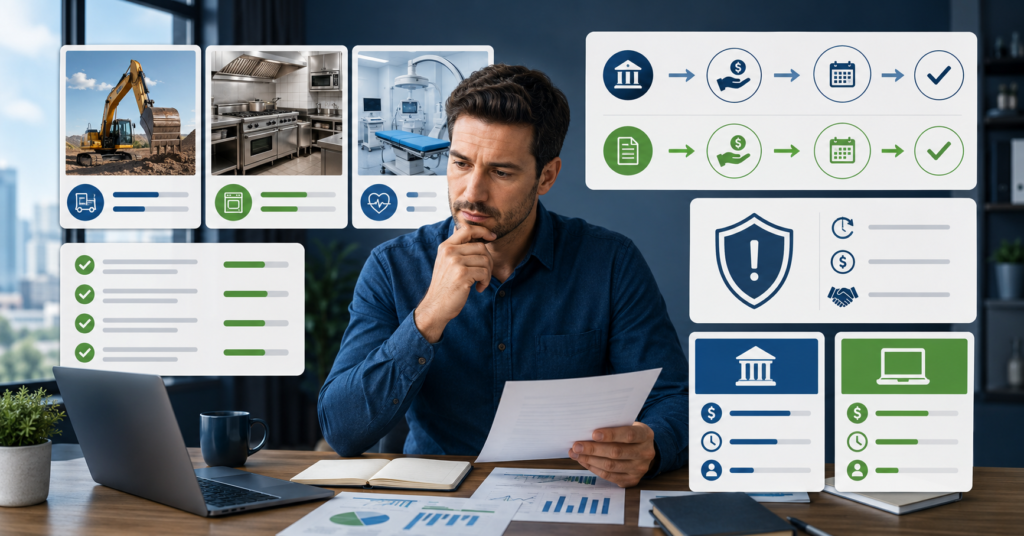
Best equipment financing companies for small business 2026 is a high-intent finance keyword.
Most readers are not looking for a simple definition. They want to compare lenders, lease options, costs, ownership, and application requirements before choosing a provider.
Equipment financing can help small businesses buy or lease business assets such as machinery, vehicles, medical equipment, restaurant equipment, POS systems, or IT hardware.
However, the best option depends on the equipment type, business age, credit profile, cash flow, and whether the business wants to own or use the equipment.
This guide is for comparison only. It is not financial advice. Always verify current rates, fees, repayment terms, and lease-end conditions with the provider before applying.
What Is Equipment Financing?
Equipment financing is a funding structure used to acquire business equipment.
It may come as an equipment loan, equipment lease, SBA-backed loan, bank financing, or online lender option.
The equipment itself may act as collateral in many structures. This can make equipment financing different from a general working capital loan.
Common equipment financed by small businesses
- Construction equipment
- Commercial vehicles
- Manufacturing machinery
- Medical and dental equipment
- Restaurant equipment
- POS systems
- IT hardware
- Office equipment
The key decision is not only the interest rate.
Small businesses should compare ownership, useful equipment life, total repayment amount, fees, and lease-end terms.
Equipment Financing vs Equipment Leasing
Equipment financing and equipment leasing are related, but they are not the same.
Financing usually focuses on buying equipment. Leasing usually focuses on using equipment while preserving cash flow.
Equipment loan
An equipment loan is usually a purchase-focused structure.
The business borrows money to buy the equipment and repays the loan over time.
- Best for: Businesses that want long-term ownership.
- Main benefit: The business can keep the equipment after repayment.
- Watch out: Approval criteria, down payment, fees, and total repayment amount can vary.
Equipment lease
An equipment lease focuses on access and use.
The business makes scheduled payments to use equipment, but ownership depends on the lease structure.
- Best for: Businesses that want flexibility.
- Main benefit: It may reduce upfront cash pressure.
- Watch out: Lease-end terms can affect the final cost.
Best Equipment Financing Companies in 2026
The providers below are commonly mentioned in equipment financing comparisons.
However, some numbers come from comparison sources and may not be official. Confirm all current terms directly with each provider.
1. Crest Capital
Crest Capital is often discussed as an equipment-focused financing provider.
It may fit businesses that want a provider focused on equipment purchases rather than general-purpose funding.
- Best for: Equipment-focused financing.
- Potential strength: Dedicated equipment financing process.
- Watch out: Loan amount, credit requirements, and term ranges should be verified on the official site.
2. Balboa Capital
Balboa Capital is often mentioned for speed-focused equipment financing.
It may fit business owners who need to replace or acquire equipment quickly.
- Best for: Faster funding comparison.
- Potential strength: Speed and online process.
- Watch out: APR and total repayment cost can vary by profile and offer.
3. Currency Capital
Currency Capital is often discussed for larger equipment financing needs and diverse asset types.
It may fit businesses that need to finance expensive equipment or multiple assets.
- Best for: Larger equipment purchases.
- Potential strength: Broad equipment financing marketplace structure.
- Watch out: Final terms may depend on the lender or partner offer.
4. National Funding
National Funding is often mentioned as an option for businesses with weaker credit profiles.
It may fit some owners who cannot qualify for traditional bank financing.
- Best for: Businesses comparing lower-credit options.
- Potential strength: Access for some borrowers outside bank standards.
- Watch out: Costs may be higher. Always compare total repayment amount.
5. Taycor Financial
Taycor Financial is often discussed for startups and used equipment financing.
It may fit newer businesses that need equipment but have limited operating history.
- Best for: Startups or used equipment comparison.
- Potential strength: Flexible equipment categories.
- Watch out: Startup approval depends on many factors and should not be assumed.
6. Lendio
Lendio is a financing marketplace, not a single direct lender.
It can help small businesses compare multiple funding options, including equipment financing.
- Best for: Comparing multiple lender offers.
- Potential strength: Marketplace access.
- Watch out: Final terms come from partner lenders, not the marketplace itself.
7. First Citizens Bank
First Citizens Bank is a bank-based option often mentioned for larger or more structured equipment financing.
It may fit established businesses that want a bank relationship.
- Best for: Bank-style equipment financing.
- Potential strength: Structured financing for qualified borrowers.
- Watch out: Bank underwriting may be more conservative.
Equipment Financing Company Comparison Table
| Provider | Best For | Potential Strength | Main Caution |
|---|---|---|---|
| Crest Capital | Equipment-focused financing | Dedicated equipment process | Verify current terms officially |
| Balboa Capital | Speed-focused comparison | Fast process potential | Total cost can vary |
| Currency Capital | Larger equipment needs | Broad asset financing | Final terms may depend on partners |
| National Funding | Lower-credit comparison | Alternative access potential | Costs may be higher |
| Taycor Financial | Startups and used equipment | Flexible categories | Approval is case-specific |
| Lendio | Marketplace comparison | Multiple lender options | Not the final lender |
| First Citizens Bank | Bank-style financing | Structured financing | More conservative underwriting possible |
Loan Types and Lease Structures to Compare
Equipment financing is not one fixed structure.
Before applying, compare the structure behind the offer.
Equipment loan
An equipment loan is usually best when the business wants to own the equipment long term.
This can fit construction, manufacturing, medical, or restaurant equipment that will remain useful for years.
FMV lease
An FMV lease, or fair market value lease, may offer a purchase option at the end of the lease based on market value.
It can fit equipment that may need to be upgraded later.
- May support lower monthly payments in some cases.
- May offer more flexibility at lease end.
- Final purchase price is not always fixed upfront.
$1 buyout lease
A $1 buyout lease is closer to a purchase structure.
The business may be able to buy the equipment at the end for a very low amount, depending on the contract.
- May fit businesses that want ownership.
- Can work like installment-style financing.
- Total cost should be compared carefully.
Operating lease
An operating lease focuses more on using equipment than owning it.
It may fit assets that become outdated quickly.
- May fit technology or equipment with shorter useful life.
- Can support upgrade flexibility.
- May be inefficient if long-term ownership is the goal.
Rates, Fees, Terms, and Eligibility
Equipment financing costs can vary widely.
APR, fees, repayment term, down payment, credit score, business age, revenue, and equipment type all matter.
Costs to compare
- APR or equivalent cost measure
- Origination fees
- Prepayment penalties
- Late fees
- Returned payment fees
- Documentation fees
- Lease-end purchase or return costs
- Total repayment amount
Do not choose a provider by interest rate alone.
Total repayment amount and lease-end conditions can change the true cost.
Best Equipment Financing Option by Business Situation
The best equipment financing company depends on the business situation.
A restaurant buying kitchen equipment has different needs from a trucking company buying vehicles or a clinic buying medical devices.
If speed matters most
Online equipment financing providers may help when equipment must be replaced quickly.
However, faster funding may come with higher cost. Compare APR, fees, repayment schedule, and total repayment amount.
If credit is weaker
Some alternative lenders may be more flexible than banks.
Still, approval is not guaranteed. The business should compare current eligibility rules and avoid offers with unclear fees.
If the business is a startup
Startups may have fewer financing options because they have limited operating history.
Some providers may consider newer businesses, but requirements vary. Down payment, credit, equipment value, and owner profile may matter.
If the equipment is expensive
For expensive equipment, bank financing, SBA-related options, or larger equipment finance providers may be worth comparing.
In this case, documentation and review may take more time.
If the equipment becomes outdated quickly
An operating lease may be useful when equipment needs frequent upgrades.
This can apply to some technology, IT hardware, or specialized equipment.
If long-term ownership matters
An equipment loan or $1 buyout lease may fit better.
But the business should compare total cost over the equipment’s useful life.
Common Mistakes to Avoid
1. Looking only at the interest rate
A lower advertised rate does not always mean the lowest total cost.
Fees, repayment schedule, prepayment rules, and lease-end costs can change the final amount.
2. Ignoring equipment life
The repayment term should make sense for the equipment’s useful life.
If the equipment becomes outdated before the financing ends, the structure may create cash flow pressure.
3. Missing lease-end terms
Lease-end terms are critical.
Review purchase options, return fees, renewal clauses, residual value responsibility, and equipment condition rules.
4. Confusing marketplaces with direct lenders
A marketplace can help compare offers, but it may not be the final lender.
Always check which company provides the actual financing agreement.
5. Applying too widely without a plan
Multiple applications without a strategy can create confusion.
Prepare documents, compare terms, and understand eligibility before applying.
FAQ
What is the difference between equipment financing and equipment leasing?
Equipment financing usually focuses on buying and eventually owning the equipment.
Equipment leasing focuses on using the equipment, with ownership depending on the lease terms.
Can startups get equipment financing?
Some providers may work with startups, but approval depends on credit, business profile, equipment type, and other factors.
Startup financing should be compared carefully because terms can vary.
Can I finance used equipment?
Some providers may finance used equipment.
However, eligibility may depend on equipment condition, age, value, and lender policy.
Is an equipment loan better than a lease?
It depends on the business goal.
If ownership matters, a loan or $1 buyout structure may fit. If flexibility matters, a lease may be worth comparing.
Can SBA financing be used for equipment?
SBA-related financing may be used for eligible business equipment in some cases.
Exact rules and lender requirements should be verified before applying.
What fees should I check before signing?
Check origination fees, documentation fees, late fees, prepayment penalties, returned payment fees, and lease-end costs.
Also compare the total repayment amount.
Should I choose the fastest equipment financing company?
Not always.
Speed can matter, but total cost, equipment life, ownership, and lease-end terms are also important.
Final Verdict
Best equipment financing companies for small business 2026 is a strong finance comparison keyword.
The safest angle is not “lowest rate” or “fastest approval.”
The stronger angle is equipment life, ownership, total repayment amount, lease-end terms, and provider fit by business situation.
Crest Capital, Balboa Capital, Currency Capital, National Funding, Taycor Financial, Lendio, and First Citizens Bank are common names to compare. Still, every current offer should be verified directly with the provider before applying.