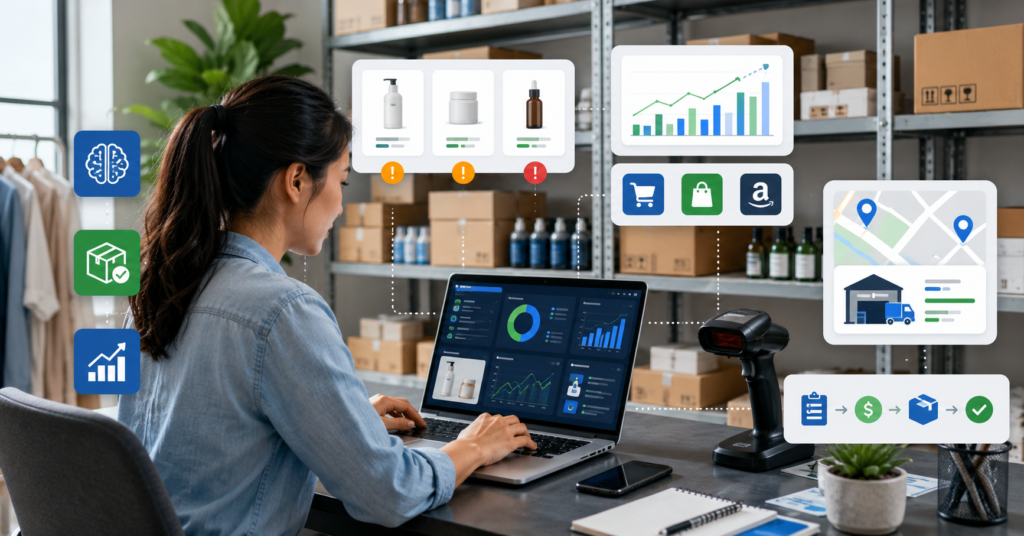
Finding the best AI inventory management software for small business in 2026 is not only about tracking stock.
Small businesses need better forecasting, faster reorder alerts, ecommerce integrations, barcode support, and cleaner inventory reports.
However, each tool serves a different type of business. A Shopify seller does not need the same system as a small manufacturer or wholesale company.
This guide compares the best AI inventory management software for small business in 2026. It focuses on features, automation, pricing notes, business fit, and key weaknesses.
What Is AI Inventory Management Software?
AI inventory management software helps businesses track stock, predict demand, and automate inventory workflows.
Traditional inventory tools only record what happened. AI inventory tools try to help teams decide what to order next, when to reorder, and where stock may run low.
Why AI matters for small business inventory
Small businesses often lose money from stockouts, overstocking, and slow manual updates.
AI and automation can help reduce these problems. For example, a tool may suggest reorder points, forecast demand, or trigger low-stock alerts.
Still, AI is not the only buying factor. Small businesses also need simple pricing, ecommerce integrations, barcode scanning, and usable reports.
Common AI and automation features
The strongest tools usually support more than basic tracking.
- Demand forecasting
- Low-stock alerts
- Automatic reorder points
- Purchase order creation
- Barcode or QR scanning
- Multi-channel inventory sync
- Warehouse location tracking
- Automated inventory reports
In most cases, the best tool is the one that fits your workflow first. AI features only help when the core inventory system is strong.
How to Choose the Right Tool for a Small Business
Before you choose software, define your inventory problem.
Some businesses need better Shopify inventory sync. Others need warehouse control, barcode scanning, demand forecasting, or manufacturing workflows.
Budget and pricing
Pricing matters because inventory tools can become expensive fast.
Zoho Inventory may fit budget-focused teams. Cin7 starts at a higher price point but offers deeper multi-channel and forecasting features. NetSuite usually fits larger and more complex teams.
Therefore, compare pricing with your order volume, channels, users, and warehouse needs.
Forecasting and automation
Forecasting is a major reason to consider AI inventory software.
If your business often runs out of popular items, demand forecasting and reorder alerts may be worth paying for.
However, not every tool has deep AI forecasting. If a feature is unclear, check the official product page before buying.
Ecommerce and barcode support
Ecommerce sellers need inventory sync across channels.
Look for integrations with platforms like Shopify, Amazon, eBay, Etsy, QuickBooks, POS tools, and shipping systems.
Barcode support is also important if you manage stock in a warehouse, retail store, or storage room.
Quick Comparison: Best AI Inventory Management Software
The table below gives a fast buying overview.
Pricing and AI features can change. Always check the official pricing page before making a final decision.
| Tool | Best For | AI or Automation Feature | Pricing Note | Best Business Type | Main Weakness |
|---|---|---|---|---|---|
| Cin7 | Growing multi-channel brands | ForesightAI and advanced automation | Starts around $349/month; AI add-ons may cost extra | Retail and wholesale | Higher price and complexity |
| Zoho Inventory | Budget-focused SMBs | Automation, barcode tools, basic forecasting support | Free plan available; paid plans start around $29/month | Small ecommerce sellers | Advanced forecasting is weaker |
| Katana | Small manufacturers | Manufacturing workflow automation | Unclear in source data | DTC and manufacturing | Not a pure forecasting tool |
| Sortly | Simple visual tracking | QR and barcode automation | Free trial and paid plans available | Small teams and asset tracking | Weak ecommerce and forecasting depth |
| inFlow Inventory | B2B and wholesale | Reorder and workflow automation | Unclear in source data | Wholesale SMBs | Less public detail in source data |
| Fishbowl | QuickBooks users | Workflow automation | Unclear in source data | Manufacturing and warehouse teams | Learning curve may be high |
| NetSuite | Scaling operations | ERP-level automation and analytics | Quote-based | Larger or complex SMBs | May be overkill for many small businesses |
| Shopify Inventory Apps | Shopify-only sellers | App-dependent automation | Varies by app | Single-channel Shopify sellers | Features may be fragmented across apps |
Best AI Inventory Management Software for Small Business in 2026
Each tool below fits a different inventory workflow.
Use this section to match your business type, sales channel, budget, and automation needs.
1. Cin7: Best for growing multi-channel brands
Cin7 is a strong inventory platform for growing retail, wholesale, and multi-channel businesses.
It supports inventory, orders, MRP, B2B workflows, POS, warehouse tools, and many integrations. It also offers ForesightAI and advanced automation features.
- Best for: growing multi-channel brands
- AI or automation: ForesightAI, demand forecasting, automation, and related features
- Ecommerce fit: strong, with many integrations
- Pricing note: starts around $349/month; some AI features may be add-ons
- Main weakness: high price and complexity
Cin7 can be a strong fit when stockouts, multi-channel sales, and warehouse complexity are serious problems.
However, it may be too expensive for very small teams.
2. Zoho Inventory: Best budget-friendly option
Zoho Inventory is a practical option for smaller ecommerce and retail businesses.
It supports orders, purchase orders, backorders, barcode tools, stock counting, and integrations with ecommerce platforms.
- Best for: budget-focused SMBs
- AI or automation: automation, contextual support, and basic forecasting-related features
- Ecommerce fit: works with common platforms such as Shopify, Amazon, eBay, and Etsy
- Pricing note: free plan available; paid plans start around $29/month
- Main weakness: weaker advanced forecasting than premium tools
Zoho Inventory is one of the best starting points for cost-sensitive teams.
It is not the deepest AI forecasting tool, but it can cover many core SMB needs.
3. Katana: Best for small manufacturers
Katana is a strong fit for small manufacturers and DTC brands.
It focuses on inventory, production planning, order management, and manufacturing workflows. This makes it different from simple ecommerce inventory tools.
- Best for: small manufacturers and DTC product brands
- AI or automation: workflow automation and integrated data support
- Ecommerce fit: can connect with tools such as Shopify, QuickBooks, and Xero
- Pricing note: unclear in source data
- Main weakness: not a dedicated AI forecasting platform
Katana is useful when inventory is tied to production.
If your business only needs simple stock counts, Katana may be more than you need.
4. Sortly: Best for simple visual inventory tracking
Sortly is built for simple, visual inventory and asset tracking.
It is useful for small teams that want photos, QR codes, barcodes, and mobile-first tracking.
- Best for: small teams, asset tracking, and simple inventory
- AI or automation: QR and barcode workflow automation
- Ecommerce fit: limited compared with multi-channel tools
- Pricing note: free trial and paid plans available
- Main weakness: weak demand forecasting and ecommerce depth
Sortly is a good option when ease of use matters most.
However, it may not fit ecommerce sellers who need deep platform sync.
5. inFlow Inventory: Best for B2B and wholesale
inFlow Inventory can fit B2B sellers, wholesale businesses, and teams that need practical inventory workflows.
It supports inventory tracking, purchase workflows, sales workflows, and reorder automation.
- Best for: B2B, wholesale, and field sales workflows
- AI or automation: reorder and workflow automation
- Ecommerce fit: integration details should be checked on the official site
- Pricing note: unclear in source data
- Main weakness: less public detail in the research data
inFlow may work well when B2B selling and practical stock control matter more than advanced AI.
Before choosing it, confirm pricing, integrations, and automation features.
6. Fishbowl: Best for QuickBooks users
Fishbowl is often considered by businesses that use QuickBooks and need stronger inventory or warehouse support.
It can fit manufacturing, warehouse, and barcode-heavy workflows.
- Best for: QuickBooks-connected warehouse or manufacturing teams
- AI or automation: workflow automation features exist
- Ecommerce fit: best checked by current integration details
- Pricing note: unclear in source data
- Main weakness: learning curve and interface complexity
Fishbowl may be useful when QuickBooks accounting is already central to your business.
However, it may feel heavier than modern ecommerce-first tools.
7. NetSuite: Best for scaling enterprises
NetSuite is an ERP-level system, not a lightweight inventory app.
It can support complex inventory, financials, reporting, workflows, and large operations.
- Best for: larger or more complex businesses
- AI or automation: ERP-level automation and analytics
- Ecommerce fit: broad, but setup may be more complex
- Pricing note: quote-based
- Main weakness: overkill for many small businesses
NetSuite can be powerful. But most small businesses should only consider it when their operations are already complex.
8. Shopify Inventory Apps: Best for Shopify-only sellers
Shopify inventory apps can be a good choice for sellers who only need Shopify-focused workflows.
These apps may help with inventory alerts, forecasting, purchase orders, and stock sync. Features vary by app.
- Best for: Shopify-only sellers
- AI or automation: depends on the app
- Ecommerce fit: strongest for Shopify-native workflows
- Pricing note: varies by app
- Main weakness: features can be fragmented across multiple apps
Shopify apps are easy to install.
However, they may not replace a full inventory system when your business expands to multiple channels.
Side-by-Side Buying Guide
Use the table below to narrow your shortlist.
| Business Need | Best Tool | Why It Fits |
|---|---|---|
| Multi-channel retail | Cin7 | Strong integrations, forecasting, and automation |
| Low-cost ecommerce | Zoho Inventory | Affordable entry point and useful integrations |
| Small manufacturing | Katana | Production and inventory workflows |
| Simple stock tracking | Sortly | Visual tracking, QR codes, and mobile use |
| B2B wholesale | inFlow Inventory | Practical wholesale and reorder workflows |
| QuickBooks warehouse workflows | Fishbowl | Inventory depth for QuickBooks-connected teams |
| Complex scaling operations | NetSuite | ERP-level inventory and financial workflows |
| Shopify-only selling | Shopify apps | Native Shopify workflow and app-based setup |
Which Tool Fits Your Business Type?
The best AI inventory management software for small business depends on how you sell and manage stock.
Do not choose the most advanced tool first. Choose the tool that solves your current bottleneck.
If you sell across many channels
Choose Cin7.
It fits businesses that sell through Shopify, Amazon, wholesale, POS, and other channels. It is stronger when inventory sync and forecasting matter.
If you want a budget-friendly option
Choose Zoho Inventory.
It fits small ecommerce sellers that need core inventory features without a high starting cost.
If you manufacture products
Choose Katana or Fishbowl.
Katana may fit modern DTC manufacturing workflows. Fishbowl may fit businesses tied closely to QuickBooks and warehouse operations.
If you need simple tracking
Choose Sortly.
It fits teams that need visual inventory, barcode labels, QR codes, and mobile access more than deep AI forecasting.
If you are outgrowing small-business tools
Consider NetSuite.
But treat it as an advanced ERP system. It can be too complex for many small businesses.
FAQ
What is the best AI inventory software for small business in 2026?
Cin7 is strong for growing multi-channel businesses. Zoho Inventory is better for budget-focused SMBs. Sortly works well for simple visual tracking.
Which inventory tool has the best demand forecasting?
Cin7 is one of the strongest options in this list for forecasting-focused inventory management. However, confirm the current ForesightAI details before buying.
What is the cheapest good inventory software for SMBs?
Zoho Inventory is one of the strongest budget-friendly choices. It offers a free plan and affordable paid plans, based on the source data.
Which tool works best with Shopify and QuickBooks?
Cin7 and Katana may work well for Shopify and QuickBooks-connected workflows. Fishbowl is often considered by QuickBooks-heavy inventory teams.
Do small businesses really need AI inventory features?
Not always. A small team may only need stock tracking and low-stock alerts. AI forecasting becomes more useful when demand changes often or stockouts cost money.
Which software is best for retail versus manufacturing?
Cin7 fits retail and wholesale better. Katana and Fishbowl fit manufacturing workflows better. Sortly fits simple stock or asset tracking.
Conclusion
The best AI inventory management software for small business in 2026 should help you control stock without adding too much complexity.
If you need strong multi-channel features, start with Cin7. If you need a lower-cost tool, compare Zoho Inventory. If you need simple visual tracking, test Sortly.
For manufacturing, compare Katana and Fishbowl. For complex scaling operations, consider NetSuite only when you truly need ERP-level control.
Start with your biggest inventory problem. Then choose the tool that solves it with the least friction.