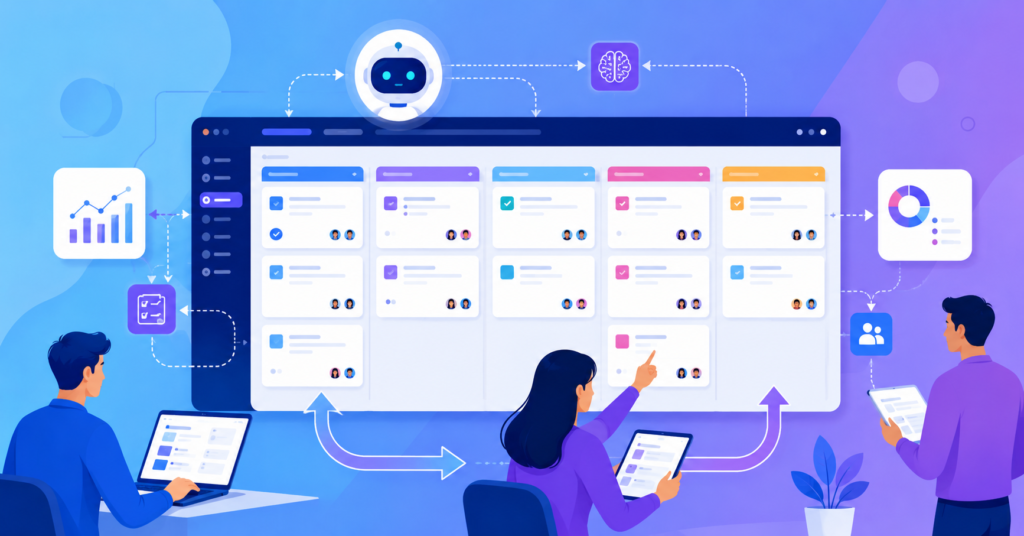
I started looking seriously at ai project management software after realizing my team was spending more time updating tasks than actually finishing them. Everyone looked busy, but projects kept slipping. Meetings got longer, status updates got more repetitive, and simple admin work kept eating into the hours that should have gone toward actual work. After testing a few different approaches, the biggest lesson was straightforward: AI doesn’t replace people. It removes the low-value work that slows them down.
Most teams don’t fail because they lack capable people. They fail because information gets lost, priorities drift, and managers end up spending half their time chasing updates instead of making decisions.
Why Traditional Project Management Fails Team Productivity
The Hidden Costs of Manual Task Tracking
Manual task tracking feels manageable when a team is small. Updating a spreadsheet, sending a status message, reassigning a task — none of it seems like a big deal at first. But as projects grow more complex, those small administrative tasks start stacking up in ways that aren’t obvious until the damage is already done.
The problem I kept running into was duplicated effort. People were updating information in multiple places, managers were manually checking progress, and meetings were being scheduled just to collect information that should have already been visible. None of that work moved anything forward.
The real cost isn’t just time — it’s focus. Every manual update is a context switch. Over weeks and months, that adds up to a noticeable drag on the whole team. And when reporting is driven by manual processes, problems tend to surface after a deadline has already started slipping rather than before.
Communication Silos in Modern Remote Work
Remote work creates flexibility, but it also scatters information across chat platforms, email threads, meeting notes, and project boards. Important updates get buried inside long conversations. Decisions made in one channel don’t make it to the people who need them.
I’ve worked on projects where everyone was genuinely trying hard, but marketing had one set of priorities, operations had another, and leadership was making decisions based on incomplete information. Nobody was slacking — the system just wasn’t designed to keep people aligned.
These silos slow everything down. Teams spend time searching for information instead of acting on it. The larger the organization, the more expensive that problem becomes. Traditional project management tools store information. AI-enhanced tools help surface the right information at the right moment.
How AI-Driven Solutions Transform Modern Workflows
The best ai project management software works by automating repetitive administrative tasks while providing predictive insights about project progress. Instead of requiring managers to manually gather status updates, AI systems continuously analyze activity and flag potential risks before they become serious problems.
Automating Repetitive Admin with Smart Assistants
The first thing most teams notice when they switch to an AI-powered system is how much time they were losing to coordination overhead. Administrative work rarely creates value on its own, but it consumes a surprising amount of hours every week.
AI assistants reduce that burden by handling routine coordination automatically — organizing project information, supporting workflow automation, and reducing the need for manual check-ins. Project managers stop acting as data collectors and start spending more time on actual decisions.
Automation also improves consistency in a way that human processes can’t easily match. A manual workflow depends on people remembering to follow it. An automated workflow runs the same way every time, which reduces variability and makes project outcomes more predictable.
Real-Time Predictive Insights for Resource Planning
Traditional project management is mostly backward-looking — you find out something went wrong after it already did. AI-driven systems shift that dynamic by helping teams see what’s likely to happen before it becomes a problem.
For resource planning specifically, this matters a lot. Figuring out whether workloads are balanced or whether a project is quietly heading toward a deadline miss is genuinely hard to do manually. Predictive insights give managers earlier visibility so they can adjust before it’s too late.
That shift — from reactive coordination to proactive leadership — is one of the main reasons AI adoption in project management keeps growing. It’s not about replacing judgment. It’s about giving managers better information to act on.
Top AI Project Management Software for Different Team Needs
One thing that frustrates me about most software reviews is that they treat every organization as if it has the same needs. A five-person startup and a 500-person agency are not evaluating tools the same way, and they shouldn’t be.
See Top SMB AI PM Tools
Best Affordable Solutions for SMBs and Startups
Smaller teams usually need simplicity before sophistication. A lightweight system that automates routine work delivers more practical value than a feature-heavy enterprise platform that requires weeks of onboarding and a dedicated admin to maintain.
The best SMB options focus on high-impact automation without overwhelming users. They reduce manual tracking, simplify collaboration, and improve visibility without demanding extensive setup. Cost matters too — smaller teams need software that produces real productivity gains without introducing overhead that cancels out the benefit.
When evaluating options for a smaller team, I’d focus on three things: how fast the team can actually adopt it, what routine work it eliminates on day one, and whether the pricing makes sense at your current scale.
Robust Enterprise Tools for Scaled Operations
Enterprise organizations face a different set of problems. The challenges are usually about scale — managing complex project portfolios, coordinating across departments, and maintaining visibility when dozens of teams are working simultaneously.
At that level, AI becomes more valuable because even modest efficiency improvements multiply across a large workforce. Deeper resource planning, broader workflow visibility, and stronger predictive capabilities matter more when the cost of a missed deadline affects hundreds of people.
The key distinction is that enterprise tools need to support structured processes while still delivering actionable insights across the organization — not just at the project level.
Comparing Key Features and Real-World Pricing
Side-by-Side Usage Comparison Table
Most reviews list features but don’t explain who those features actually benefit. That’s a real problem, because a startup and a large agency aren’t evaluating software the same way and shouldn’t be using the same comparison framework.
A useful comparison separates SMB requirements from enterprise requirements and evaluates tools based on automation capabilities, predictive planning, workflow support, ease of adoption, and how well the tool fits the actual complexity of your projects.
The most important question isn’t which platform has the most features. It’s which platform removes the most friction from how your team actually works. More features don’t help if half of them never get used.
Feature-to-Price Value Analysis
The best value comes from matching features to actual needs rather than paying for capabilities your team will never touch. SMBs generally benefit from affordable automation and fast implementation. Enterprise organizations tend to prioritize scalability, predictive planning, and deeper workflow management that can handle organizational complexity.
Instead of asking which platform has the longest feature list, ask which platform solves the most expensive problems inside your team right now. That reframe tends to lead to much better purchasing decisions.
Want a free AI Project Management Toolkit? Drop your email and I’ll send the full comparison sheet directly to you.
Find Your Best AI PM Match
Choosing Your Tool: Reddit-Proven Recommendations
Insights from Active Project Management Communities
One pattern that keeps coming up in real project management communities is a shift in what people are actually looking for. It’s less about basic task tracking and more about tools that actively assist with workflow — meeting notes, proactive planning, and coordination that doesn’t require constant manual input.
The strongest recommendations in community discussions tend to come from tools that reduce daily workload in ways people can feel immediately. Users aren’t impressed by feature counts. They remember which tools actually made their week easier.
Alternative Tools Often Overlooked by Big Reviews
Large review sites tend to rank the most well-known platforms and skip over niche solutions that might fit specific team structures better. That’s especially true for SMBs that need focused automation without enterprise-level complexity and pricing to match.
Community recommendations often surface tools that prioritize usability and workflow fit over brand recognition. A platform doesn’t need to be the market leader to deliver meaningful value — it just needs to solve the right problems for your team size and working style.
FAQ: Everything You Need to Know About AI PM Tools
Implementation and Data Security Concerns
What is the best AI tool for project management?
The best tool depends on your specific workflow, but current leaders focus on integrating task automation with predictive analytics. Choose a tool that bridges the gap between simple task tracking and the kind of resource planning your projects actually need.
How does AI help in project management?
AI handles repetitive administrative tasks and provides predictive insights into project timelines. That frees managers to focus on strategy and team leadership instead of spending hours on manual data entry and status collection.
Which AI project management software is best for small teams?
Small teams benefit most from lightweight tools that deliver high-impact automation without excessive complexity. Look for software that separates SMB-focused features from heavy enterprise requirements so you’re not paying for capabilities you won’t use.
Future-Proofing Your Team’s Productivity
What AI tools are project managers actually using right now?
Based on recent community discussions, managers are gravitating toward tools that offer workflow automation and AI assistants for meeting notes. The focus has shifted from passive tracking dashboards to systems that proactively help move projects forward.
Can AI replace a project manager?
AI is built to assist, not replace — it handles resource planning and predictive scheduling so managers can focus on decisions that require human judgment. The manager stays responsible for team dynamics and strategic direction; AI handles the data work underneath.
Your team’s productivity shouldn’t depend on manual tracking. Find the right tool and let AI handle the busywork.
Compare AI PM Tools Now
As more organizations look for smarter ways to coordinate work, the right ai project management software can eliminate repetitive overhead, sharpen planning visibility, and give teams the space to focus on execution rather than administration.