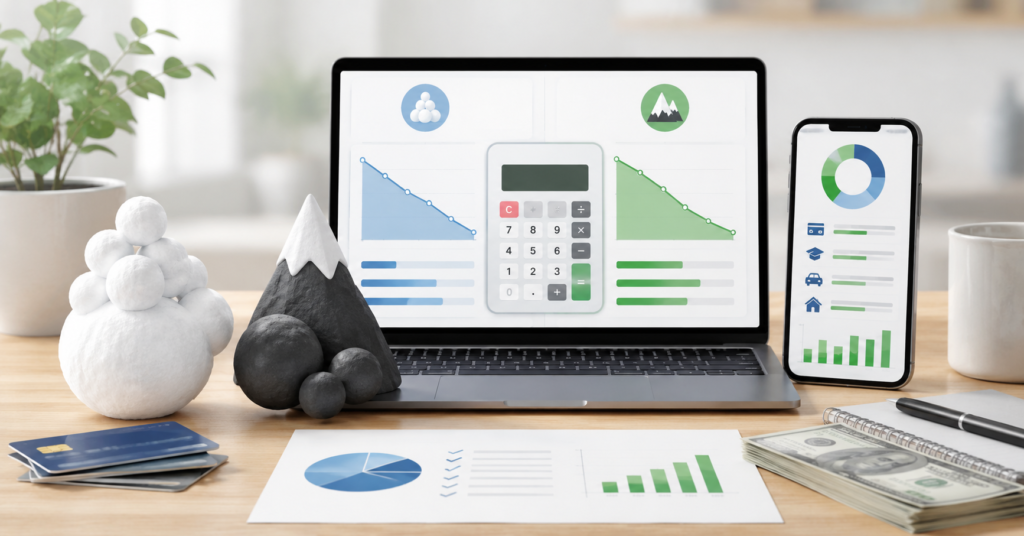
If you’ve been searching for a debt snowball vs avalanche calculator free 2026 tool, you’re probably past the point of just wanting general advice. You want to know which method actually gets you out of debt faster — and whether the difference is big enough to matter. Here’s the honest answer: debt avalanche usually saves more money on interest, but debt snowball keeps more people from quitting halfway through.
Both strategies work. The mistake isn’t picking snowball over avalanche or vice versa. The real mistake is choosing a method that sounds good on paper but falls apart in month two when life gets in the way. This guide breaks down both approaches, shows you how to compare them with free tools, and helps you build a plan you’ll actually stick to.
Overcoming Debt Stress: Snowball or Avalanche?
Which debt payoff method should you choose?
Choose debt snowball if staying motivated is your biggest challenge. Choose debt avalanche if minimizing total interest paid is your priority. Either way, running your numbers through a calculator first makes the decision much clearer.
The Psychological Toll of Debt
Debt isn’t purely a numbers problem — and that’s exactly why purely mathematical advice often fails. When your total balance feels enormous, it’s easy to freeze up instead of acting. The stress affects more than your finances. It shows up in sleep, focus, and how you make decisions day to day.
The debt snowball method was built around this reality. By knocking out the smallest balance first, you get a real win quickly — one that makes the rest of the plan feel possible. That payment then rolls into the next debt, building momentum as you go. It’s not magic. It’s just psychology working in your favor.
The avalanche method feels different in the early stages. It targets your highest interest rate first, which is mathematically correct, but can feel slow if that debt also carries a large balance. The tradeoff is real: slower emotional progress, lower total interest paid.
Choosing the Right Strategy for Your Goals
The right method is the one that matches how you actually behave under pressure — not how you plan to behave when motivation is high. If you need visible proof that something is working, snowball probably fits your wiring better. If you’re already disciplined about money and losing sleep over interest charges, avalanche is worth the slower start.
A free calculator removes the guesswork. You plug in your real balances, interest rates, minimum payments, and whatever extra amount you can put toward debt each month — and it shows you the side-by-side difference before you commit to anything.
How the Debt Snowball Method Works
Debt snowball ranks your debts from smallest balance to largest. You pay minimums on everything, then throw every extra dollar at the smallest balance until it’s gone. Then that payment rolls into the next one.
Small Wins for Big Motivation
The reason snowball works for so many people isn’t complicated. Paying off a debt — even a small one — gives your brain concrete evidence that the plan is working. That matters more than most financial advice acknowledges.
Imagine you’re carrying four debts:
- Credit card A: $450 balance
- Medical bill: $900 balance
- Credit card B: $3,800 balance
- Personal loan: $7,000 balance
With snowball, you attack the $450 first — even if another debt has a nastier interest rate. Once that card hits zero, you roll its payment into the medical bill. The wins come faster early on, and that keeps you moving.
When to Choose Snowball Over Avalanche
Snowball makes the most sense when your biggest risk is giving up. If you’re feeling overwhelmed, carrying several small balances, or you’ve tried paying down debt before and stopped, the emotional reinforcement snowball provides is genuinely valuable.
It’s also the simpler method to follow. No need to analyze interest rates or recalculate payoff order. List debts by balance, attack the smallest, repeat. The downside is cost — ignoring interest rates in the early stages usually means paying more in total interest over time.
Maximizing Savings with the Debt Avalanche Method
Debt avalanche ranks your debts from highest interest rate to lowest. Minimums go on everything, and your extra payment goes entirely toward the highest-rate debt until it’s eliminated.
Focusing on High-Interest Rates
The logic here is straightforward: the debt charging you the most is the one costing you the most every single month. Attack it first and you stop the bleeding faster.
If one credit card is running at 28% APR while a personal loan sits at 8%, avalanche sends every extra dollar toward that 28% card. The high-rate debt shrinks faster, and the total interest you pay over the life of your debt drops — sometimes by a lot.
This approach works especially well when your high-interest debt is also a meaningful chunk of your total balance. The savings can be significant enough to change your financial timeline by months or even years.
Calculating Your Potential Interest Savings
The clearest way to understand the avalanche advantage is to actually run the numbers — not estimate them. A calculator can show you exactly how much interest you’d pay under each method, given your specific balances and rates.
In many scenarios, avalanche beats snowball by hundreds or thousands of dollars in interest. But the gap depends entirely on your individual situation. If your smallest debt happens to also carry the highest interest rate, both methods produce nearly identical results anyway.
Comparing Payoff Timelines for 2026
How can you compare debt snowball and avalanche accurately?
Use a calculator that lets you enter each debt’s balance, interest rate, minimum payment, and extra monthly amount. Then compare payoff dates, total interest, and monthly progress for both methods side by side.
Using Online Comparison Tools
A calculator strips the emotion out of the first decision. You can still choose snowball for motivational reasons — but you should see the actual numbers first, not just the theory.
I ran my own numbers through this calculator and the results genuinely surprised me: try the AAPS Debt Calculator for 2026.
The most useful calculators will show you:
- Total payoff time for each method
- Total interest paid under each method
- Your projected debt-free date
- The impact of adding extra monthly payments
- Side-by-side snowball vs avalanche comparison
Don’t just look for which method wins on paper. Look for which method you’ll actually follow through on every month for the next year or two.
Projecting Your Debt-Free Date
Your debt-free date is more flexible than most people realize. Even an extra $50 or $100 a month can shorten the timeline noticeably — and a calculator lets you test those scenarios before you commit.
Try three versions: one with no extra payment, one with a modest extra amount, and one with an aggressive payoff plan. That range gives you something realistic to work with rather than an optimistic projection that falls apart when an unexpected expense hits.
Free Debt Payoff Planner PDF
Before you start, it helps to have everything in one place. Download our free Debt Payoff Planner PDF to organize your balances, interest rates, minimum payments, extra payoff amount, and target debt-free date on a single page.
The planner works best alongside a calculator — the calculator gives you the timeline, the planner helps you follow it week by week without losing track.
Modern Debt Tracking: Spreadsheets vs. Mobile Apps
Picking a payoff method is step one. Actually tracking your progress month after month is what determines whether you finish. Without a system, even a solid plan fades when life gets stressful.
Top Free Spreadsheets for 2026
Spreadsheets are still one of the most reliable free options for debt tracking — especially if you want full control over how your data looks.
A solid debt payoff spreadsheet should include:
- Debt name and lender
- Current balance
- Interest rate
- Minimum monthly payment
- Extra payment amount
- Payoff order
- Monthly progress column
The main drawback is manual entry. If you skip updates for a few weeks, the sheet stops reflecting reality — and that disconnect makes it easy to disengage from the plan entirely.
Mobile App Integration for On-the-Go Tracking
Apps make daily tracking easier because the barrier to checking in is lower. You don’t need to open a laptop — a 30-second update on your phone is enough to keep the plan visible.
I’ve been using this tracker for six months and it’s done more for my consistency than any spreadsheet I’ve tried: try Undebt.it for debt payoff tracking.
The best system isn’t the most sophisticated one. It’s the one you’ll open every week without thinking twice about it.
Frequently Asked Questions
Which pays off debt faster: snowball or avalanche?
Avalanche typically pays off debt faster in total time — and saves more in interest — when you stay consistent. Snowball can actually be faster in practice for people who need early wins to stay motivated and avoid quitting.
Is debt avalanche better than snowball?
On a spreadsheet, yes — avalanche usually wins on total interest paid. In real life, it depends on your behavior. A snowball plan you stick with beats an avalanche plan you abandon after three months.
Debt snowball vs avalanche: which is best for 2026?
The best method in 2026 is the same as any other year: the one that matches how you actually behave under pressure. Use avalanche for maximum interest savings. Use snowball if you need momentum to stay consistent.
What are the pros and cons of each method?
Snowball is simple and psychologically rewarding, but it often costs more in total interest. Avalanche saves more money overall, but the early stages can feel slow if your highest-interest debt is also a large balance.
Which method works better for credit card debt?
Avalanche tends to work better for credit card debt specifically, because card APRs are often high enough that targeting them first produces meaningful savings. That said, if you’re holding several small card balances and need quick wins, snowball can still get the job done.
Final Verdict
The best debt payoff strategy isn’t always the one with the lowest total interest cost. It’s the one you can execute consistently, month after month, until every balance hits zero.
Start with snowball if you need motivation. Start with avalanche if you want to minimize cost. Either way, start by running your actual numbers — not estimates — so you know exactly what you’re committing to.
A debt snowball vs avalanche calculator free 2026 tool shows your real payoff timeline, projected interest, and debt-free date before you make any decisions. Join the list below to get the free Debt Payoff Planner PDF and start building a plan that actually holds up.