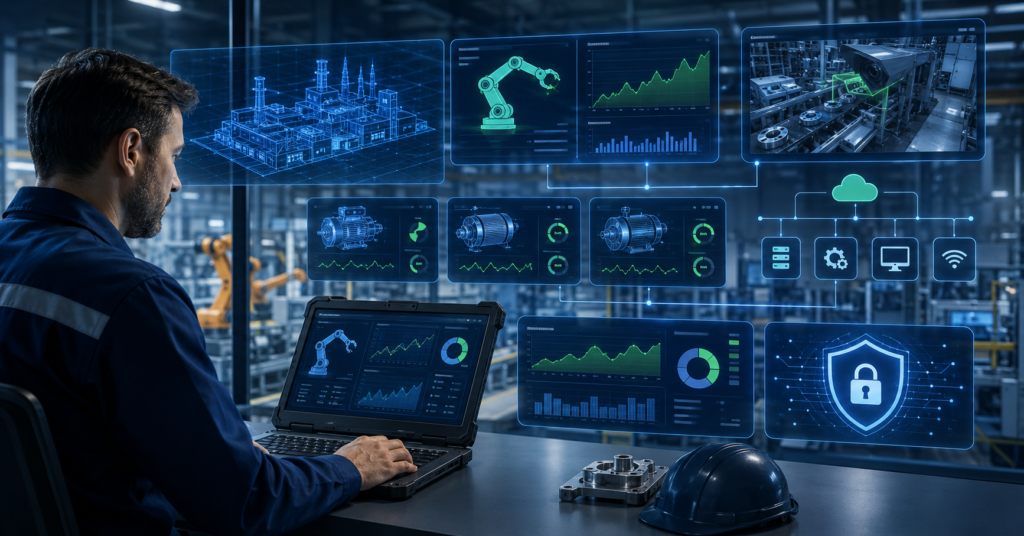
Finding the best AI tools for manufacturing companies 2026 is not just about buying another software platform.
Manufacturing teams need tools that fit real factory workflows. These include predictive maintenance, quality inspection, production monitoring, planning, digital twins, robotics, and factory analytics.
However, AI should not replace manufacturing managers, engineers, or factory workers. It can help teams review data, detect patterns, and support better decisions.
This guide compares manufacturing AI tools by use case, pricing style, integrations, pros, cons, and adoption risks.
Top AI Tools for Manufacturing by Primary Use Case
Manufacturing companies use AI because factories create large amounts of operational data.
Machines, sensors, quality systems, production lines, maintenance logs, ERP platforms, and MES tools all produce information.
AI tools may help connect this information and turn it into useful signals.
Leading Solutions for Predictive Maintenance and Asset Management
Predictive maintenance is one of the most common AI use cases in manufacturing.
Instead of reacting only after equipment fails, manufacturers can use sensor data and machine signals to support maintenance planning.
Tools such as Augury and IBM Maximo are often compared in this area.
- Augury: Equipment health monitoring and predictive maintenance support
- IBM Maximo: Enterprise asset management and maintenance operations
- PTC ThingWorx: Industrial IoT and connected equipment data
- Sight Machine: Factory data visibility and operational analytics
These tools can help teams see equipment issues earlier. Still, maintenance decisions should be reviewed by qualified people.
Best AI Tools for Manufacturing Companies in 2026
The best AI tool depends on the manufacturing problem.
A quality team may need machine vision. A maintenance team may need sensor-based prediction. A process team may need digital twin simulation.
Quick Comparison Table
| Category | Recommended Tools | Pricing Note | Core Users |
|---|---|---|---|
| Predictive maintenance | Augury | Quote-based or subscription | Maintenance and facility managers |
| Quality inspection | Cognex VisionPro, Cognex In-Sight | Quote-based or package-based | Quality and automation engineers |
| Production monitoring | Sight Machine, MachineMetrics | Demo or quote may be required | Production technology and plant operations teams |
| Production planning | IBM Maximo, Odoo | Subscription or enterprise pricing may apply | Asset and operations managers |
| Supply chain optimization | PTC ThingWorx, Sight Machine | Often quote-based | OT, IT, and supply chain teams |
| Digital twins | NVIDIA Omniverse, AnyLogic | Free and paid options may exist | Simulation and process engineers |
| Generative AI for engineering | Siemens Industrial Copilot, ChatGPT, Claude, Gemini | Subscription or quote-based | Engineers and documentation teams |
| Workforce training | Siemens Industrial Copilot, general LLM tools | Subscription or quote-based | Trainers and field workers |
Many industrial AI tools do not publish simple fixed pricing. Buyers should request official quotes before making a decision.
Integrating AI into Existing Factory Infrastructure
Manufacturing AI tools rarely work alone.
They usually need to connect with factory systems, operational data, and engineering platforms.
This is why integration is one of the most important buying factors.
Connecting OT and IT: ERP, MES, and SCADA Integration
Before buying, manufacturers should check whether the tool can connect with these systems:
- ERP: Supports production planning, finance, and business operations.
- MES: Connects production history, work orders, and shop-floor execution.
- SCADA: Supports real-time monitoring and control data.
- IoT sensors: Feed condition data into predictive maintenance systems.
- PLC data: Helps connect machine-level signals with analytics.
- CAD and PLM: Support digital twin and engineering workflows.
- Cloud platforms: Store, process, and scale manufacturing data.
For example, predictive maintenance tools may need IoT sensors, PLC data, or SCADA connections.
Quality inspection tools may need camera systems, production-line data, and MES connections.
Digital twin tools may require CAD, PLM, simulation data, and cloud infrastructure.
Evaluating the Pros and Cons of Industrial AI Platforms
Each manufacturing AI platform has a different strength.
Some tools are built for equipment health. Others focus on machine vision, factory analytics, simulation, or engineering support.
Balancing Simulation Capabilities with Implementation Complexity
| Tool Group | Pros | Cons |
|---|---|---|
| Augury | Strong for equipment prediction and operational visibility | Public pricing may not be available, and implementation can be costly |
| Cognex VisionPro and In-Sight | Useful for machine vision and automated quality inspection | Line-by-line setup and hardware dependency can be significant |
| Sight Machine | Strong for OT and IT data connectivity | Value may drop if factory data quality is poor |
| NVIDIA Omniverse and AnyLogic | Useful for digital twins and simulation scenarios | Model building skills and internal expertise may be required |
| Siemens Industrial Copilot | Can support engineering documentation and troubleshooting | Safety verification and approval steps are still needed |
In many cases, the tool is only one part of the project.
Manufacturers also need clean data, trained users, clear ownership, and review rules.
Pricing and Buying Notes
Pricing for manufacturing AI tools can vary widely.
Many enterprise tools are quote-based. Some use subscriptions. Some combine software, hardware, sensors, and services.
Quote-Based Pricing and Official Confirmation
Manufacturers should use cautious pricing assumptions.
- Augury: Pricing is usually described as quote-based or subscription-style.
- IBM Maximo: Enterprise pricing may require official confirmation.
- Cognex: Vision and deep learning packages may depend on hardware and region.
- Odoo: Community and enterprise options may exist, depending on needs.
- NVIDIA Omniverse and AnyLogic: Free and paid options may apply.
Buyers should not compare only license cost.
Implementation, data cleanup, sensor installation, training, cybersecurity, and support can affect total cost.
Critical Risks and Considerations Before Adoption
Manufacturing AI can help teams find patterns. However, it also creates serious operational risks.
Factories involve machines, people, safety procedures, production deadlines, and sensitive data.
For this reason, AI output should be reviewed before it affects operations.
The Importance of Data Quality and Factory Safety
Review these risks before buying:
- Data quality: Messy or incomplete data can reduce AI performance.
- Factory safety: AI should support safety teams, not replace them.
- Model accuracy: Results can change when environments or production conditions change.
- Cybersecurity: Factory systems and operational data need strong protection.
- Implementation cost: Setup, training, sensors, and integration can add cost.
- Workforce adoption: Tools fail when teams do not trust or use them.
- Vendor lock-in: Critical workflows may become dependent on one provider.
Manufacturers should define approval rules before rollout.
For safety, maintenance, quality, and production decisions, qualified people should remain responsible for the final review.
How B2B Software Blogs Can Monetize This Topic
The keyword best AI tools for manufacturing companies 2026 has strong B2B buying intent.
Readers are usually comparing tools before requesting demos or quotes.
This makes the topic useful for lead generation and SaaS referral content.
Demo Requests, Consultation CTAs, and Deep-Dive Pages
A B2B software blog can monetize this article in several ways:
- Demo request buttons after comparison tables
- Quote request CTAs for enterprise tools
- Consultation forms for factory AI tool selection
- Separate pages for predictive maintenance AI tools
- Separate pages for quality inspection and machine vision tools
- Separate pages for digital twin software and factory analytics
Because many industrial tools use quote-based pricing, lead generation may be stronger than simple affiliate links.
However, the article should stay practical first. Readers need clear categories, integration notes, and risk warnings.
FAQ: Best AI Tools for Manufacturing Companies 2026
What is the best AI tool for predictive maintenance in manufacturing?
Augury is often discussed for equipment health monitoring and predictive maintenance. The right fit depends on sensors, machine data, and maintenance workflow.
Which AI tools work with MES and SCADA?
Industrial platforms such as PTC ThingWorx, Sight Machine, and similar tools may support factory data connections. Buyers should confirm current integration details.
How much do manufacturing AI tools cost?
Many manufacturing AI tools use quote-based or subscription pricing. Hardware, sensors, implementation, and training can also affect total cost.
Can AI tools integrate with ERP and PLC data?
Yes, many tools are designed to connect with ERP, MES, SCADA, IoT sensors, PLC data, CAD, PLM, or cloud platforms. Integration should be checked before purchase.
What are the biggest risks when adopting AI in a factory?
The biggest risks include poor data quality, factory safety, model accuracy, cybersecurity, implementation cost, workforce adoption, and vendor lock-in.
Final Takeaway
The best AI tools for manufacturing companies 2026 are the tools that match real factory problems.
Start with one clear use case. It may be predictive maintenance, quality inspection, production monitoring, digital twins, or factory analytics.
Then check integrations with ERP, MES, SCADA, IoT sensors, PLC data, CAD, PLM, and cloud systems.
AI can help manufacturers manage complex data and support better decisions. But data quality, safety review, and human expertise remain critical.