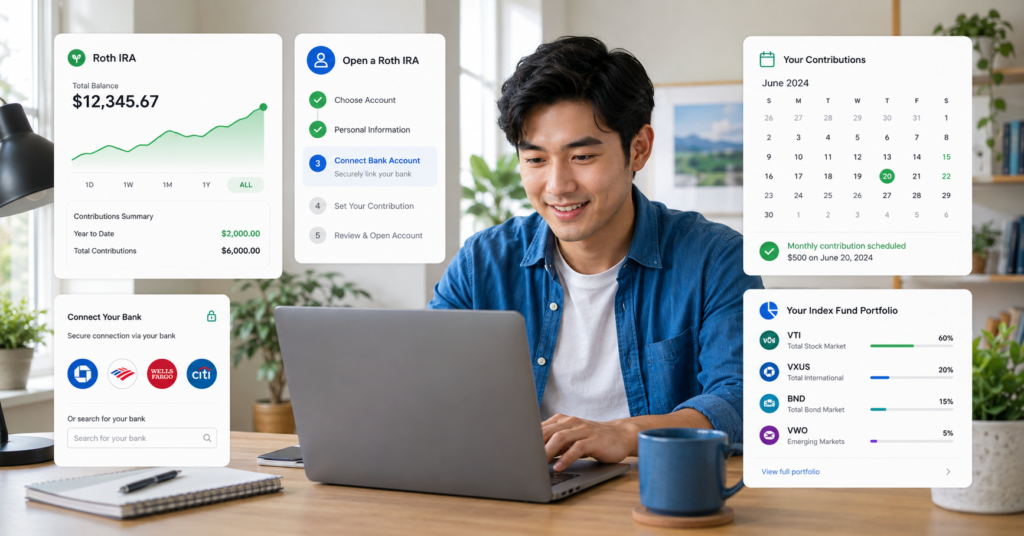
I opened my Roth IRA last year, and the first hour felt genuinely confusing.
However, once I understood how to open a Roth IRA step by step, the whole process clicked into place.
First, you check eligibility. Then you choose a platform, open the account, connect your bank, fund it, and pick investments.
Therefore, this guide keeps every stage simple and skips the financial jargon.
Also, it covers 2025 income limits, platform comparisons, routing numbers, and automatic contributions.
Why Beginners Struggle to Start a Roth IRA
Most beginners do not struggle because Roth IRAs are complicated.
They struggle because every platform uses different words for the same basic steps.
To open a Roth IRA step by step, choose a provider, create an account, verify your identity, connect your bank, fund it, and select investments.
Most people can finish the entire setup online in one sitting.
However, contribution limits and income rules still matter before you fund anything.
Overcoming Choice Overload and Technical Barriers
When I started, I spent more time comparing apps than actually opening the account.
In fact, the form itself was not hard at all.
The hard part was knowing which choices actually mattered.
First, you need earned income for the current tax year.
Next, check whether your MAGI allows a direct Roth IRA contribution.
Finally, you need a bank account that can send ACH transfers.
Many beginners also worry about picking the wrong investment on day one.
However, you do not need a complex portfolio to get started.
A simple index fund is enough for most long-term investors.
Also, you can adjust future contributions anytime after opening.
Therefore, the real goal is not a perfect portfolio.
The real goal is opening the account correctly and funding it every month.
- Check your earned income first.
- Confirm your 2025 Roth IRA income range.
- Choose a beginner-friendly platform.
- Connect your checking account.
- Set a contribution amount you can sustain monthly.
- Pick simple, diversified investments to start.
As a result, the whole process becomes a checklist instead of a mystery.
Choosing the Right Platform for Your Needs
Your platform should match how involved you actually want to be with your investments.
However, most beginners end up choosing based on ads rather than actual workflow fit.
I would compare M1 Finance and Betterment first because they serve very different habits.
M1 Finance suits people who want control paired with automation.
Betterment suits people who want a guided portfolio with fewer decisions to make.
Start investing with M1 Finance and get a $10 bonus when you make your first deposit.
Comparing M1 Finance and Betterment for Ease of Use
M1 Finance uses customizable portfolios called Pies.
For example, you can build a Pie with ETFs and assign target percentages to each slice.
Then M1 automatically invests new deposits toward those targets.
Betterment works differently — it asks about your goals, timeline, and risk tolerance upfront.
Next, it builds and manages a diversified portfolio based on your answers.
Additionally, it handles rebalancing and dividend reinvestment automatically.
- M1 Finance: better for hands-on investors who want automated control.
- Betterment: better for beginners who want guided portfolio management.
- M1 Finance: useful when you already know your preferred ETFs.
- Betterment: useful when you want help choosing your asset allocation.
- M1 Finance: offers more customization through portfolio slices.
- Betterment: offers more automated guidance around retirement goals.
However, ease of use depends entirely on your personality.
If too many choices overwhelm you, Betterment will probably feel simpler.
If you enjoy building your own mix, M1 Finance will feel more natural.
Therefore, do not choose the app with the longest feature list.
Choose the app that actually helps you fund the account every single month.
In fact, consistency matters far more than which logo is on your dashboard.
How to Open a Roth IRA Step by Step: Opening Your Account
This is the exact order I would follow as a complete beginner.
First, gather your Social Security number, home address, employment details, and bank information.
Next, select Roth IRA as the account type — not taxable brokerage.
Then complete the identity verification questions and review the account agreement before submitting.
Also, check our related anchor text before deciding on your first deposit amount.
Navigating Online Portals and Connecting Bank Accounts
Most platforms ask the same basic questions during setup.
For example, they ask your name, birth date, citizenship, address, employment status, and investing experience level.
Then they ask how you plan to fund the account.
Your bank routing number identifies your bank during the ACH transfer process.
For example, routing numbers are nine digits and appear on checks right beside your account number.
Use your actual bank details from your banking app or a physical check — not a guess.
Before funding, check the 2025 MAGI limits carefully.
These limits determine whether you qualify for a full direct Roth IRA contribution this year.
Also, they protect high earners from making accidental excess contributions.
- Single filers under $150,000 MAGI: full 2025 contribution allowed.
- Single filers $150,000 to under $165,000: reduced contribution applies.
- Single filers at $165,000 or above: direct Roth IRA contribution not allowed.
- Married filing jointly under $236,000 MAGI: full 2025 contribution allowed.
- Married filing jointly $236,000 to under $246,000: reduced contribution applies.
- Married filing jointly at $246,000 or above: direct Roth IRA contribution not allowed.
However, a high income does not always close the door on Roth accounts entirely.
Some investors use a backdoor Roth IRA strategy instead of a direct contribution.
That means contributing after-tax money to a traditional IRA and then converting it to Roth.
In fact, the tricky part is any existing pre-tax IRA money you already hold.
Therefore, high earners should understand the pro-rata rule before attempting a conversion.
Also, having a 401(k) does not block you from opening a Roth IRA at all.
Your 401(k) and Roth IRA run on completely separate contribution systems.
However, your income can still limit direct Roth IRA contributions regardless of your 401(k) status.
As a result, always confirm eligibility before contributing — not after.
Once eligibility looks clear, connect your bank and start with a small test transfer.
Finally, confirm the money arrives correctly before scheduling a larger recurring deposit.
Funding Your Roth IRA and Selecting Investments
Opening the account is only the first step — the account does nothing until you fund it.
For 2025, the IRA contribution limit is $7,000 if you are under 50.
Also, the limit increases to $8,000 if you are 50 or older.
However, your taxable compensation for the year can also cap your total contribution.
Open and fund your Betterment account today to start building your retirement portfolio automatically.
Setting Up Automatic Contributions and Index Funds
I prefer automatic contributions because they remove the monthly temptation to skip.
First, choose a realistic transfer amount based on your actual take-home pay.
Next, schedule the transfer to run right after your paycheck arrives.
For example, a $500 monthly transfer adds up to $6,000 in contributions over one year.
Then add extra money later if your budget opens up — but start with what you can sustain.
However, never assume that cash automatically invests after it transfers in.
Some platforms park deposits in cash until you manually select investments.
Therefore, always check whether auto-invest is switched on after your first deposit clears.
Index funds keep the first portfolio simple and low-cost.
For example, many beginners start with broad stock market ETFs or a single target-date fund.
Also, some investors add a small bond allocation based on their age and personal risk tolerance.
- Use your checking account ACH for regular deposits.
- Schedule contributions monthly or after each payday.
- Turn on auto-invest if your platform supports it.
- Choose diversified index funds over individual stocks to start.
- Review your total contributions before year-end each December.
- Keep clear records if you ever use a backdoor Roth process.
Additionally, set one calendar reminder each quarter to check contributions and investment status.
Use that reminder to also verify your beneficiary details are still current.
As a result, your Roth IRA stays healthy and on track without needing constant attention.
Get the full setup breakdown here: Download our free Roth IRA Starter Checklist.
Frequently Asked Questions for Roth IRA Beginners
These are the exact questions I had before opening my own account last year.
Therefore, every answer stays simple, specific, and action-focused.
Expert Answers Based on Reddit and Common Search Trends
How much money do you need to open a Roth IRA?
Some platforms have no minimum balance requirement at all.
However, you still need enough money to actually purchase your chosen investment.
For example, platforms that support fractional shares make small starting amounts much more practical.
Also, a small first deposit helps you test the bank transfer process before committing more.
Can I open a Roth IRA if I have a 401(k)?
Yes — you can hold both a 401(k) and a Roth IRA at the same time.
However, Roth IRA income limits still apply to your direct contributions regardless.
Also, your 401(k) contribution limit does not reduce your separate IRA contribution limit.
Therefore, many savers use both accounts together when their income qualifies.
What is the maximum I can contribute to a Roth IRA in 2025?
For 2025, the limit is $7,000 if you are under 50 years old.
Also, the limit rises to $8,000 if you are 50 or older.
However, this limit applies across all your traditional and Roth IRAs combined — not per account.
Therefore, you cannot contribute the full $7,000 to both a traditional and a Roth IRA separately.
Can I start a Roth IRA if I earn over $150k?
It depends on your filing status and your actual MAGI for the year.
For single filers in 2025, the contribution phase-out begins at $150,000.
However, direct contributions are completely phased out at $165,000 for single filers.
For married filing jointly, the phase-out starts at $236,000 and ends at $246,000.
Additionally, high earners above those limits often explore backdoor Roth IRA steps instead.
Do I need to visit a branch or can I do it online?
You can open a Roth IRA entirely online — no branch visit needed.
First, choose your platform and select Roth IRA as the account type during signup.
Next, verify your identity and connect your bank account through the platform portal.
Finally, fund the account and choose your starting investments before closing the browser.
In fact, most beginners complete the entire process in under thirty minutes.
The best way to start is to make the process feel small and concrete — not overwhelming.
Check your 2025 eligibility, pick one platform, connect your bank, and make that first deposit.
Finally, remember that learning how to open a Roth IRA step by step is not about mastering finance overnight — it is about taking one clear action today. Also, join our newsletter for simple retirement checklists and beginner investing walkthroughs every week.